
A content audit is one of the most useful projects a growing website can undertake. Businesses often keep publishing because a busy calendar feels productive, yet older pages quietly become inaccurate, compete with one another or attract visitors who never become customers. A structured audit replaces that guesswork with a clear view of what exists, what performs, what serves the audience and what should happen next.
The goal is not to delete everything with low traffic or rewrite every old article. It is to make the content library more accurate, useful and aligned with business priorities. This guide explains how to inventory your pages, evaluate performance and quality, decide whether to keep, improve, combine or remove content, and build a practical refresh plan.
Start with a clear reason for the audit
An audit becomes unmanageable when it tries to solve every content problem at once. Define the main decision you need to make. You may want to recover declining organic visibility, improve lead quality, prepare for a redesign, remove outdated information or reduce overlap between articles. The purpose determines which data matters and how you prioritise work.
Write a short objective, such as: “Identify the service and educational pages most likely to improve qualified enquiries during the next quarter.” Add boundaries. Decide which domain, language, subfolder, date range and content types are included. A focused audit produces an action plan; an unlimited audit often produces a spreadsheet nobody uses.
Create a complete content inventory
Build a list of indexable pages and other assets that matter to customers. Sources can include the website sitemap, analytics landing pages, search performance reports, content management system exports and a crawl. No single source is perfect. A sitemap may omit orphaned pages, while analytics may omit pages with no recent visits.
Record the URL, title, content type, publication or update date, author or owner, target topic, intended audience and journey stage. Add the page’s main purpose: educate, compare, reassure, convert, support or retain. This inventory immediately exposes abandoned campaigns, duplicate themes, missing ownership and pages whose purpose is unclear.
Collect the right performance data
Traffic alone does not show content value. Add organic impressions, clicks, average search position and relevant engagement signals. For commercial pages, include enquiries, purchases, assisted conversions or progression to high-intent pages. For support content, reduced service questions or successful self-service may matter more than lead generation.
Use a period long enough to account for seasonality, and compare it with a meaningful previous period. Record trends rather than only totals. A page with modest traffic but steady qualified enquiries may be more valuable than a high-traffic article with no commercial relevance. Note data limitations, tracking changes and small samples so the team does not treat uncertain numbers as facts.
Evaluate search intent and audience fit
For each important page, ask what the visitor is trying to accomplish. Are they learning the basics, comparing approaches, evaluating a provider or looking for a specific next step? Then check whether the page delivers that outcome quickly and clearly. A technically accurate article can still fail if it answers a different question from the one the searcher had.
Review the search queries bringing impressions and clicks. They can reveal unexpected intent, missing subtopics and misleading titles. Compare the page with current search results to understand common formats and questions, but do not simply copy competitors. Use your own experience, examples and perspective to provide something genuinely useful.
Assess quality with human judgement
Data cannot tell you whether advice is accurate, explanations are clear or claims are properly supported. Read priority content and score it against a consistent checklist. Look for factual accuracy, completeness, clarity, originality, evidence, brand fit, accessibility and a useful next step. Confirm that dates, prices, product details, team information and external links remain current.
Ask whether the page demonstrates real understanding. Generic statements, empty introductions and repetitive sections make content feel disposable. Strong content explains why a recommendation matters, when it applies, what trade-offs exist and how a reader can act. Flag unsupported claims and examples that may expose confidential or personal information.
Check on-page SEO fundamentals
Review the page title, main heading, description, URL, subheadings, image alternative text and internal links. The primary topic should be clear without awkward repetition. Titles and descriptions should accurately set expectations rather than chase clicks. Headings should create a logical outline that lets readers scan.
Check indexability, canonical tags, redirects and broken links where relevant. Confirm that important images are compressed and descriptive. Look for pages with no internal links pointing to them and high-value pages buried too deeply in the site. Technical fixes cannot rescue weak content, but technical errors can prevent useful content from being discovered.
Identify content overlap and cannibalisation
Several pages may target the same need because different writers covered similar topics over time. This does not always create a problem, but overlap becomes harmful when pages have no distinct purpose and compete for the same queries or internal links. Group URLs by topic and intent, then compare their performance and quality.
Choose a clear primary page for each important intent. Combine useful sections from weaker pages into the strongest resource when appropriate, then redirect retired URLs carefully. If pages serve different audiences or journey stages, clarify their titles, angles and internal links instead of merging them automatically.

Use a practical decision framework
Assign one primary action to each audited URL:
- Keep: accurate, useful content performing its intended role.
- Improve: a valuable page with gaps in quality, freshness, structure or conversion.
- Combine: overlapping pages that would create a stronger single resource.
- Redirect: a retired URL with a genuinely relevant replacement.
- Remove: content with no audience value, strategic purpose or suitable destination.
- Reposition: a useful page aimed at the wrong topic, audience or journey stage.
Do not make these decisions from a single metric. A page with no visits may still contain important legal, customer-support or product information. A popular page may require improvement because it is outdated or attracts the wrong audience. Record the reasoning so future team members understand why the decision was made.
Prioritise by impact and effort
A long action list can paralyse a small team. Score each opportunity for likely business impact, audience value, confidence and effort. High-impact, low-effort fixes may include correcting inaccurate service details, improving calls to action, repairing broken internal links or refreshing a page already ranking near the first page of results.
Large rewrites and consolidations may have higher impact but require careful planning. Limit the number of pages in progress. Complete, publish and measure one batch before opening another. Prioritisation should reflect available expertise; a sensitive financial, medical or legal topic may require specialist review even if the edit appears simple.
Write a useful refresh brief
Before editing, create a short brief that explains the page’s purpose, audience, primary question, desired action and evidence of current problems. List sections to retain, gaps to fill, claims to verify, internal links to add and examples that could improve understanding. Include the target topic naturally, but let reader intent shape the structure.
A good brief prevents a refresh from becoming an unnecessary full rewrite. Preserve accurate material, established backlinks and language that already works. Add meaningful value: clearer explanations, updated data, first-hand examples, stronger navigation or better alignment with the customer journey. Changing the publication date without substantive improvement is not a real update.
Improve conversion without turning the page into an advert
Informational content should help first, but it can still guide a relevant next step. Match the call to action with the reader’s stage. An early-stage visitor may need a checklist or related guide, while a reader comparing solutions may welcome a consultation, demonstration or pricing explanation.
Place helpful internal links where they answer the next natural question. Make promotional sections proportionate to the value provided. A strong article builds trust by being useful even if the reader does not buy immediately. Avoid interruptive calls to action that make the page harder to read on mobile devices.

Handle consolidation and removal carefully
Before removing a page, check whether it receives traffic, has external links, supports a campaign or serves customers through a direct bookmark. When combining pages, move only useful and non-duplicative material. Build the new resource around a coherent intent rather than stitching every paragraph together.
Use a permanent redirect when the old URL has a close replacement. Do not redirect unrelated pages to the homepage simply to preserve traffic. Update important internal links to point directly to the destination. Keep a redirect log and test the change. Some low-value pages may be better left unavailable than redirected misleadingly.
Maintain quality during publishing
Use an editorial checklist before updates go live. Confirm facts, links, headings, spelling, image rights, alternative text, mobile layout and calls to action. Preview the page and test forms or downloads. If a change affects regulated claims or customer terms, obtain appropriate approval.
Record what changed and when. This creates a useful measurement timeline and helps diagnose unexpected results. For major pages, keep a recoverable version before editing. Coordinate with sales, support and subject experts because they often know which customer questions and objections the current content fails to address.
Measure the effect of the refresh
Choose a small set of metrics linked to the page’s purpose. These may include qualified organic clicks, visibility for relevant queries, engagement with key sections, internal-link clicks, enquiries or assisted conversions. Capture a baseline before publishing and allow enough time for meaningful comparison.
Annotate the update date and avoid attributing every change to the refresh. Seasonality, campaigns, algorithm changes and business conditions may also affect results. Review early for technical mistakes, then assess performance at a suitable interval. If outcomes do not improve, revisit the intent, offer and quality rather than making random edits.
Turn the audit into an ongoing system
A one-time clean-up helps, but content begins ageing again immediately. Assign ownership and review frequency based on risk. Pricing, product, legal and process pages may need frequent checks. Evergreen educational content can be reviewed less often unless performance or guidance changes.
Add review dates to the editorial calendar and create alerts for broken links or declining high-value pages. When publishing new content, record its purpose, intended audience and related pages. This discipline makes the next audit faster and reduces accidental overlap.
A simple 30-day content audit plan
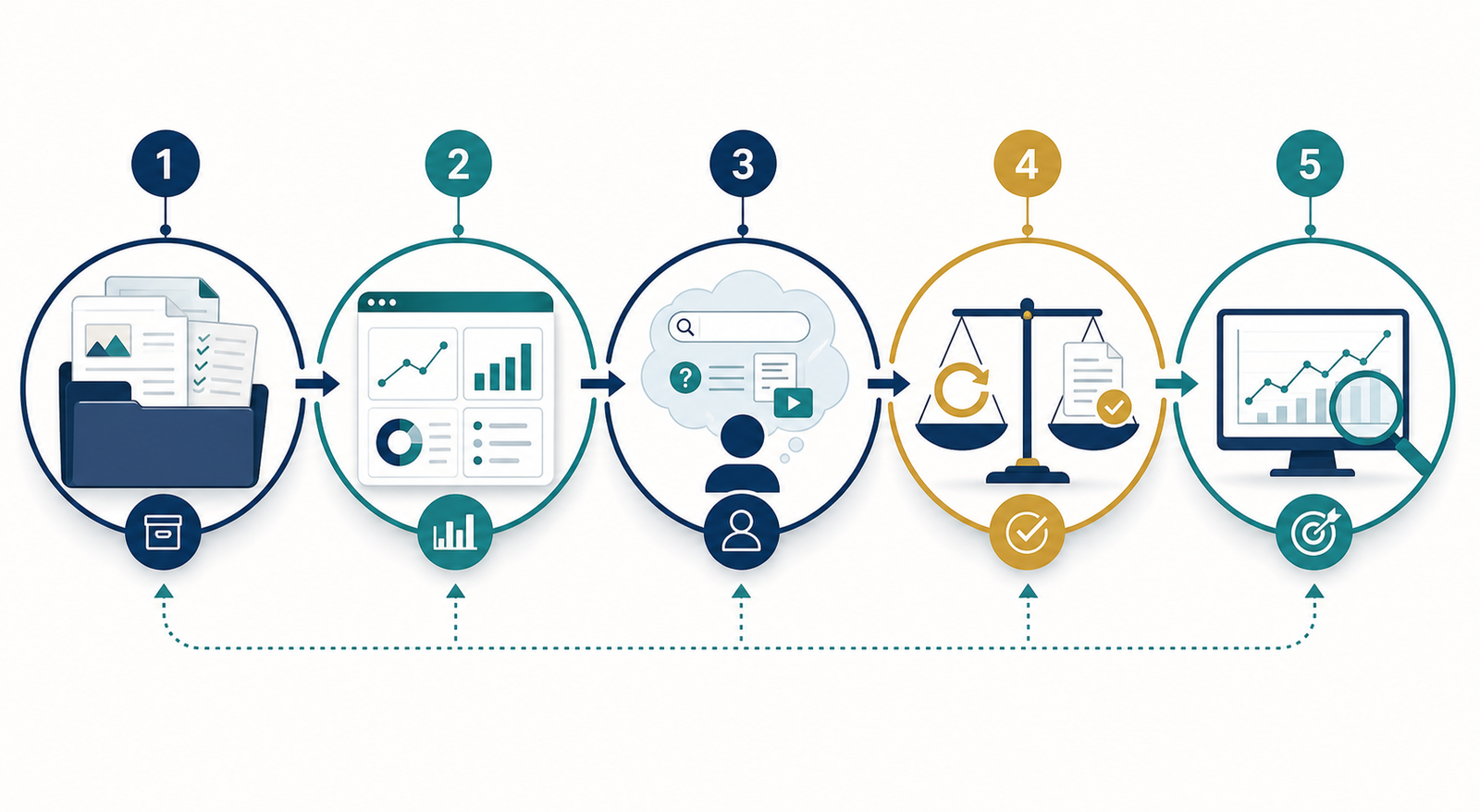
In week one, define scope, collect URLs and remove obvious duplicates from the inventory. In week two, add performance data and group pages by topic and purpose. In week three, manually review priority pages and assign decisions. In week four, create briefs and complete the highest-impact, lowest-effort updates.
Keep a separate backlog for larger consolidations, technical fixes and new content gaps. Report completed actions, lessons and early indicators rather than presenting an enormous spreadsheet. A small completed audit cycle creates more value than a perfect scoring model that never reaches publication.
Make existing content work harder
A content audit helps a business stop treating every publishing problem as a demand for more content. Often the fastest gains come from improving what customers already find: clarifying the answer, updating evidence, strengthening internal paths and removing confusion.
Begin with a focused objective and a reliable inventory. Combine performance evidence with human judgement, assign a clear action to every priority page and measure the result. Repeated regularly, this process turns a scattered archive into a useful content system that supports customers and business goals.