
A customer rarely discovers a business, clicks once and buys immediately. They may see a social post, search for advice, read a service page, open an email, compare alternatives and return days later. If a company measures each channel separately, this journey looks like disconnected activity. A customer journey measurement framework connects those touchpoints so marketing decisions reflect how people actually research and buy.
The purpose is not to track every possible interaction or claim perfect attribution. It is to understand the moments that influence progress, identify where customers become confused and connect marketing signals with genuine business outcomes. This guide explains how a small business can build a practical framework without creating an expensive analytics project.
Begin with the customer decision
Start by defining the decision the customer is trying to make. A buyer looking for an emergency local service follows a different path from a manager evaluating a long-term supplier. Consider urgency, risk, number of decision-makers, typical questions and the evidence needed to feel confident.
Interview recent customers and frontline staff. Ask how the need appeared, where research began, which information mattered, what caused hesitation and why the final option felt right. Customer language often reveals touchpoints that analytics misses, such as recommendations, offline conversations, saved screenshots and repeated visits from different devices.
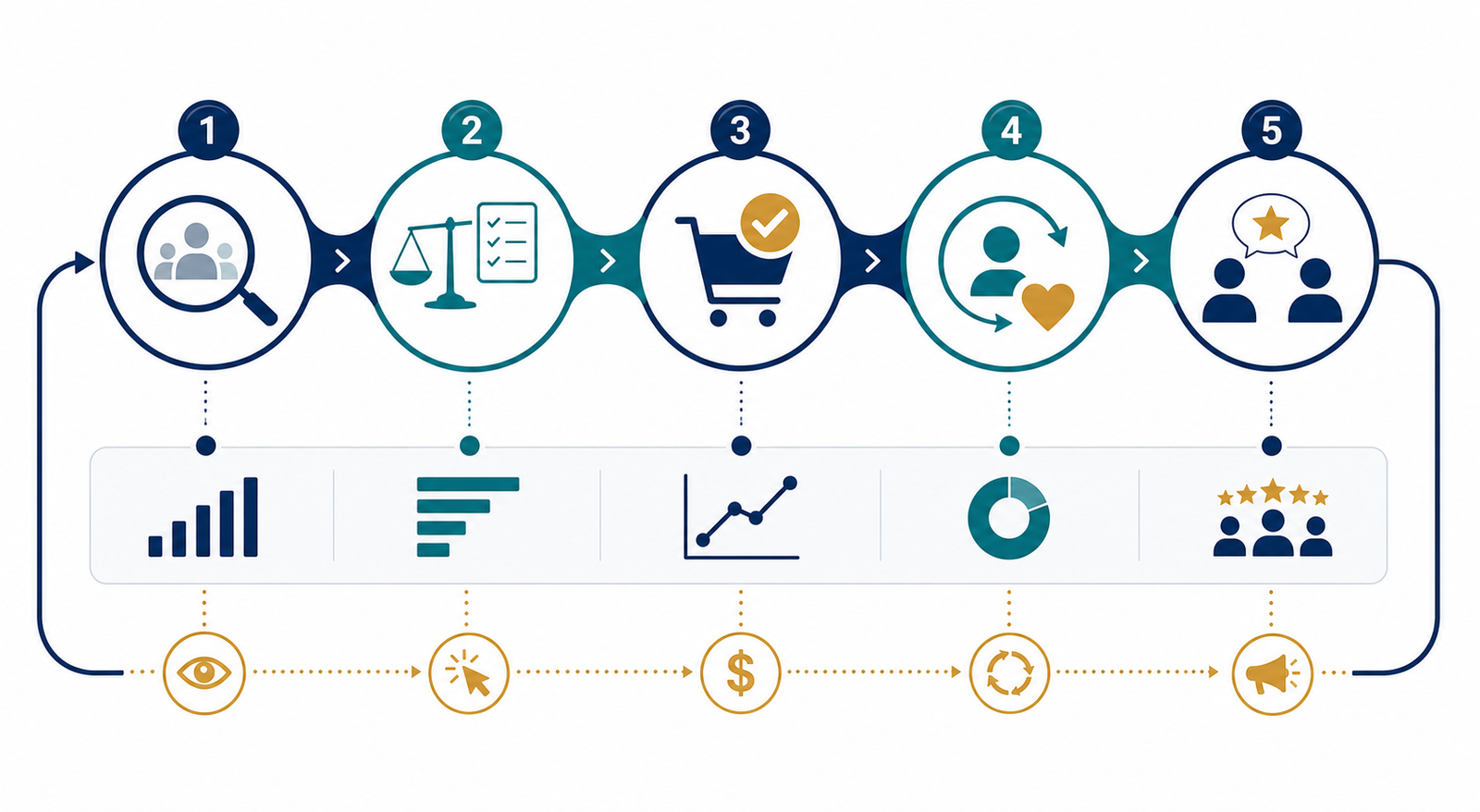
Map five useful journey stages
A simple model is usually sufficient:
- Discovery: the customer becomes aware of a problem or option.
- Consideration: they research, compare and define requirements.
- Conversion: they enquire, book, purchase or commit.
- Retention: they receive value and decide whether to return.
- Referral: they recommend, review or introduce the business.
Real journeys are not perfectly linear. A customer may move backward, pause or skip a stage. The model is valuable because it organises questions and measurements, not because every person follows the same diagram.
Define progress at each stage
Choose one meaningful customer behaviour that indicates progress. Discovery might be a relevant search impression or first qualified visit. Consideration could be viewing a case study, pricing explanation or comparison page. Conversion should reflect a genuine outcome such as a qualified enquiry or completed purchase, not merely a button click. Retention may be renewal, repeat purchase or successful onboarding.
Support each stage with a few diagnostic metrics. For consideration, these might include return visits, high-intent page views and form starts. Keep outcomes separate from diagnostics. A large number of video views may help explain awareness, but it is not equal to qualified demand.
Create a measurement plan before adding tools
List the business question, customer action, event, data source, owner and review frequency for every priority measure. Define the exact rules. What counts as a qualified lead? When is a sale attributed to a campaign? How are duplicate forms, spam and cancelled orders handled?
This measurement dictionary prevents teams from using the same words for different numbers. It also exposes gaps before implementation. If the sales team cannot reliably record lead quality or source, more website events will not solve the problem. Strengthen the process where the business outcome is confirmed.
Track only interactions that inform decisions
Analytics platforms can collect hundreds of events, but excessive tracking creates noise and maintenance. Prioritise actions tied to customer intent: completed forms, telephone clicks, bookings, purchases, quote requests, key document downloads and important journey progression.
Avoid treating shallow activity as success. Scrolling, time on page and video starts can provide context, yet they should not become primary conversions without a clear reason. Every tracked event should answer a practical question or support investigation. If nobody will act on it, it probably does not belong in the main reporting plan.
Use consistent campaign information
Clear campaign naming allows traffic from email, social, partnerships and advertising to be compared. Establish rules for source, medium and campaign values. Use lowercase conventions, avoid spaces where they cause fragmentation and maintain a shared naming sheet. Never add campaign parameters to ordinary internal links because that can overwrite acquisition information.
Test links before launch and record the destination, audience, owner and dates. Consistency is more valuable than a complicated naming system. A small taxonomy that everyone follows produces better reporting than a perfect document ignored under deadline pressure.
Connect marketing data with sales outcomes
Website analytics can show that a form was submitted, but it cannot confirm whether the prospect was suitable, attended a meeting or became profitable. Pass relevant source information into the customer relationship or sales process where possible. At minimum, record the original source, campaign, enquiry type, qualification outcome and eventual result.
Review the handoff between marketing and sales. Hidden fields, integrations and manual entry can fail. Test records and compare totals. Even a monthly reconciliation between website enquiries and accepted opportunities can reveal channels that produce many conversions but little value.

Respect privacy and consent
Collect only the information required for a legitimate purpose and follow applicable privacy rules. Explain tracking clearly, honour consent choices and control access. Avoid sending sensitive personal information into analytics platforms or campaign parameters. URLs, page titles and event labels can unintentionally expose data.
Use aggregated patterns whenever individual-level information is unnecessary. Retention limits and deletion processes should be documented. Privacy is not only a compliance task; respectful data practices protect customer trust and reduce operational risk.
Understand attribution as an estimate
Attribution models distribute credit, but they do not reveal a perfect truth. Last-click reporting favours the final interaction and can undervalue channels that created awareness or confidence. First-click reporting has the opposite weakness. Data-driven models depend on volume and platform assumptions.
Use several views when the decision matters. Compare first and last touch, assisted conversions, customer interviews and channel-level experiments. Treat attribution as evidence, not a verdict. A channel may appear indirect yet be essential to later branded search or sales conversations.
Measure journeys across devices with humility
People change devices, reject cookies, use private browsing and interact offline. A customer may research on a work computer and call from a mobile telephone. No responsible system will connect every step. Design reporting around useful trends rather than demanding an impossible individual history.
Encourage trackable but customer-friendly actions. Use memorable landing pages, consistent forms and optional “How did you hear about us?” questions. Combine digital data with qualitative research. Clearly label estimates and avoid false precision in management reports.
Find friction in the journey
For each stage, compare the number of people entering with the number progressing. A large drop may indicate weak relevance, confusing information, technical errors or natural qualification. Investigate before assuming. Watch user behaviour, test the journey yourself and speak with customers and staff.
Common problems include slow pages, unclear pricing, hidden contact details, demanding forms, inconsistent messages and delayed follow-up. Prioritise friction affecting high-intent customers or large volumes. Fix one issue, document the change and measure the result rather than redesigning everything at once.
Align channels around one journey
Search, content, social media, email and paid advertising should not behave like separate departments. Each channel has a role. Social activity may introduce an idea; useful content can explain it; a service page can provide evidence; email can support a longer decision; sales can address specific risk.
Create a channel map showing the audience, message, journey stage, destination and next step. Consistent promises reduce confusion while allowing the format to suit the channel. The customer should not encounter a helpful educational advert followed by an aggressive, unrelated landing page.

Build a decision-focused dashboard
Organise reporting by journey stage rather than platform menu. At the top, show qualified enquiries, sales, revenue or another commercial outcome. Then show acquisition quality, consideration behaviour, conversion efficiency, retention and referrals. Include comparison periods and targets where meaningful.
Add short commentary explaining material changes, confidence and next actions. A dashboard should answer what happened, why the team believes it happened and what will change. Platform-specific detail can sit in supporting views for specialists.
Use cohort analysis for longer journeys
When decisions take weeks or months, comparing this month’s spend with this month’s revenue can mislead. Group customers by first interaction or acquisition month and track how each cohort progresses. This reveals delayed conversion, retention and lifetime value more clearly.
Keep cohorts broad enough to avoid tiny samples. Compare similar time windows and note changes in pricing, offer or market conditions. Cohort reporting can show that a channel with slower initial results ultimately produces stronger customers.
Test incrementality where possible
Attribution asks who received credit; incrementality asks what happened because of the activity. Small businesses can run practical tests without advanced laboratories. Pause a campaign in a comparable location, vary spend for a limited period or test a message with a defined audience.
Set the hypothesis, primary measure, budget and decision rule before starting. Avoid changing several factors at once. Results will not always be statistically conclusive, but controlled evidence is often stronger than relying only on platform-reported conversions.
Create a useful review rhythm
Check tracking health regularly, but avoid reacting to every daily fluctuation. Weekly reviews can identify campaign issues and journey friction. Monthly reviews should connect marketing with lead quality and commercial results. Quarterly reviews can reconsider audience, channel roles and measurement priorities.
Maintain a decision log with the date, evidence, action, owner and expected result. Later reviews can judge whether the change worked. This turns measurement into organisational learning instead of a repeated presentation of charts.
A practical implementation plan
In the first month, map the journey, define outcomes and validate core conversion tracking. In the second month, standardise campaign naming and connect enquiries with sales outcomes. In the third month, build a journey dashboard, investigate the largest friction point and run one focused test.
Start with the decisions carrying the most value. Do not delay useful reporting while waiting for a perfect system. Record limitations, improve data quality over time and keep the framework understandable to the people who must use it.
Measure the journey, not just the clicks
Effective digital marketing measurement connects customer behaviour with business results while accepting that some influence remains invisible. The goal is better decisions, not total surveillance or perfect credit allocation.
Define customer progress, track meaningful actions, connect marketing with sales and use qualitative evidence to fill the gaps. When channels are evaluated as parts of one journey, the business can invest more confidently, remove friction and create a more coherent customer experience.