
PPC advertising for small businesses can create qualified traffic quickly, but speed alone does not make a campaign profitable. The real advantage of paid search is control: you can choose who sees an ad, which searches trigger it, where visitors land, how much you spend, and what counts as a successful result.
That control is valuable only when the campaign is built around sound economics and genuine customer intent. A rushed account can burn through a budget without producing meaningful leads. A disciplined account, however, becomes a measurable system for learning what customers want and turning that demand into revenue.
This guide explains how to plan, launch, measure, and improve paid search campaigns without relying on guesswork. It is designed for owners and marketing teams that want sustainable results rather than impressive-looking click reports.
What PPC Advertising Actually Does
Pay-per-click advertising allows a business to bid for visibility when people search or browse online. The advertiser usually pays when someone clicks the ad, although some campaign types optimize toward impressions, video views, leads, or conversions. Search campaigns are especially valuable because they can reach people at the moment they express a need.
PPC does not replace SEO, brand building, or a good website. It complements them. Organic visibility compounds over time, while paid search can test an offer immediately, fill gaps in organic coverage, support a launch, and capture high-intent demand. The strongest marketing programs use paid data to improve wider decisions instead of treating advertising as an isolated channel.
Begin With Business Economics
Before choosing keywords, establish what a customer or lead is worth. For ecommerce, consider average order value, gross margin, repeat purchases, refunds, and fulfillment costs. For lead generation, estimate the percentage of leads that become customers and the average profit from each customer.
Suppose a service business closes one in five qualified leads and earns $1,000 in gross profit from an average new customer. The expected gross profit per qualified lead is roughly $200. The business may decide that paying up to $70 for a lead leaves enough room for sales costs and profit. This target gives the campaign a practical boundary.
Do not confuse revenue with profit. A campaign can report a strong return on ad spend while losing money after product costs, discounts, agency fees, and overhead are included. Agree on the commercial definition of success before the platform starts optimizing.
Set One Clear Goal for Each Campaign
A campaign should have a primary objective such as completed purchases, booked consultations, qualified calls, trial registrations, or quote requests. Secondary actions—page views, video plays, and brochure downloads—can provide context, but they should not carry the same value as a sale or serious lead.
Clear goals shape every later choice. A campaign designed to generate emergency plumbing calls needs different keywords, schedules, landing pages, and response processes from one promoting a long-consideration software demo. If several goals have different economics, separate them so budgets and bids can reflect their value.
Build a Logical Campaign Structure
Account structure should mirror the way customers think about your offers. Separate major product lines, services, locations, languages, or profit models when they require different budgets or messages. Within each campaign, create tightly related ad groups that connect a specific search theme to a relevant ad and landing page.
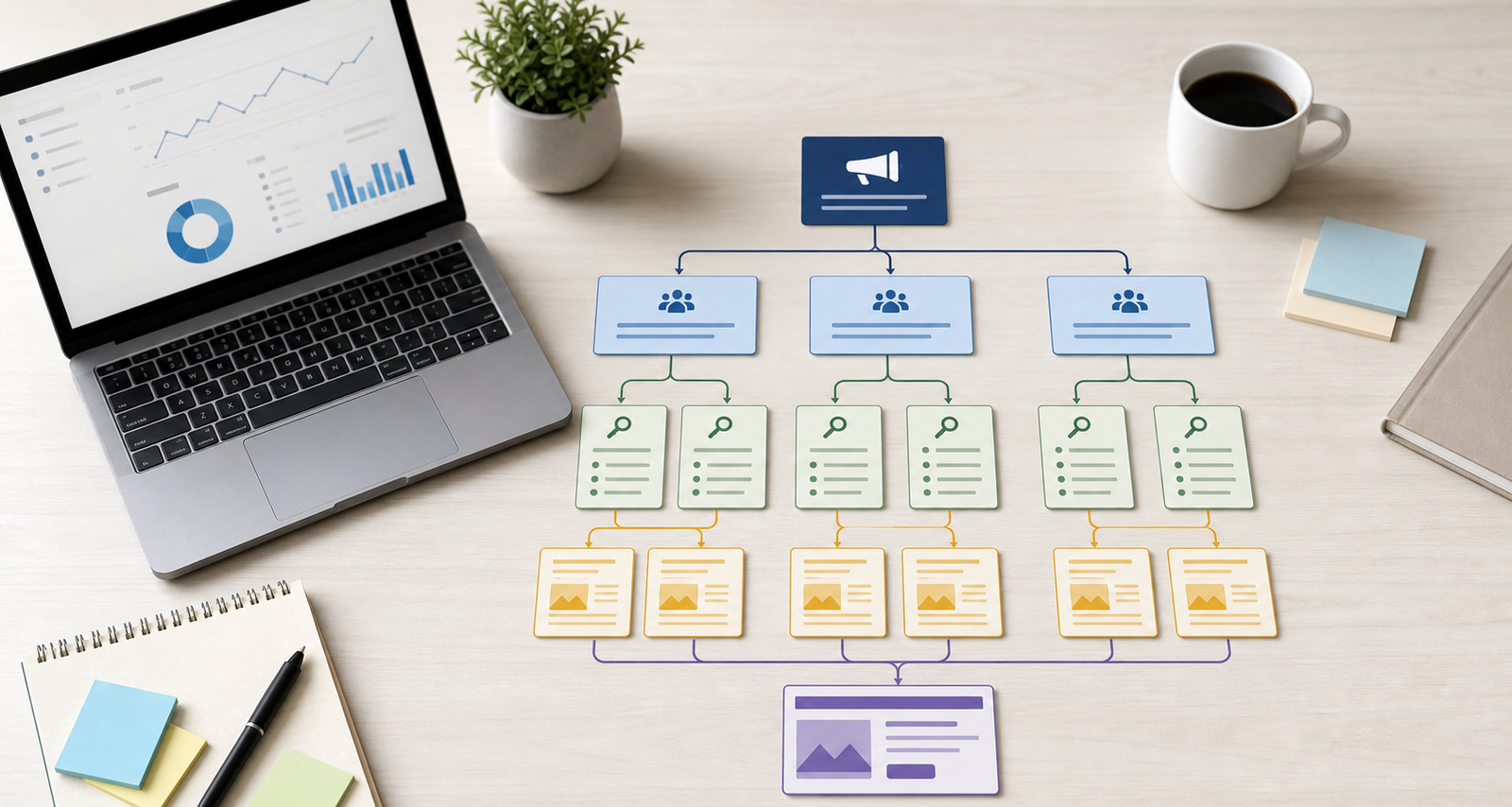
A tidy structure makes reporting and optimization easier. If one ad group mixes unrelated services, you cannot write an ad that feels specific to every searcher. Do not make the opposite mistake and create hundreds of tiny groups that are impossible to manage. Use enough separation to preserve relevance, then consolidate when themes share intent and messaging.
Research Keywords by Intent
Keyword volume shows how often a phrase may be searched, but intent indicates whether the searcher is likely to act. Terms containing a service, product type, location, urgency signal, or commercial qualifier often sit closer to a decision. Broad informational terms can still help, but they need appropriate content and should not consume the same budget as high-value searches without evidence.
Group keywords by the problem being solved. Include natural variations, but avoid building a list from every remotely related suggestion. Review actual search terms after launch; they reveal the language people use and expose irrelevant traffic that keyword-planning tools cannot predict.
Use match types deliberately
Exact and phrase match provide more control, while broader matching can discover additional demand and give automated bidding more data. Broad reach is safest when conversion tracking is trustworthy, negative keywords are maintained, and the account has enough history to distinguish valuable behavior. New or tightly budgeted campaigns often benefit from a controlled starting point.
Build a negative keyword system
Negative keywords prevent ads from showing for searches that are clearly irrelevant or commercially unsuitable. Common examples involve jobs, free resources, definitions, do-it-yourself instructions, or locations outside the service area, but exclusions must reflect the business. Review the search-term report regularly and document why negatives are added so useful demand is not blocked accidentally.
Write Ads That Match the Search
An effective search ad confirms relevance, communicates a benefit, reduces uncertainty, and gives a clear next step. Include the service or product naturally, highlight a meaningful differentiator, and set an accurate expectation. Specific proof—transparent pricing, verified experience, fast availability, a guarantee, or a clear process—is more persuasive than empty superlatives.
Use available ad assets such as sitelinks, callouts, structured snippets, prices, locations, and call options when relevant. These assets provide more information and help searchers choose the right path. Keep them current; an expired promotion or incorrect phone number can waste clicks and damage trust.

Create Landing Pages That Continue the Promise
The landing page should feel like the natural next step after the ad. If the ad promotes a specific service, do not send visitors to a generic homepage and make them find it again. Repeat the core offer, explain benefits and process, answer likely objections, provide credible proof, and make the call to action obvious.
Mobile usability is critical. Pages should load quickly, forms should request only necessary information, and phone numbers should be easy to tap. Use readable type, clear spacing, and strong contrast. Remove distractions that do not support the conversion, but provide enough information for a visitor to make a confident decision.
Message match matters more than decorative design. A beautiful page will still underperform if the visitor searched for one thing and encounters another. Align keyword, ad, offer, page headline, and conversion action around the same intent.
Set Up Conversion Tracking Before Launch
Optimization depends on trustworthy measurement. Track completed purchases, submitted lead forms, booked appointments, qualified calls, and other actions tied to business value. Test each conversion from ad click to confirmation. Remove duplicate tags and ensure refreshes or repeated visits do not inflate results.
For lead generation, platform data should connect with the customer relationship system when possible. A form submission is not necessarily a qualified opportunity. Importing later-stage outcomes helps distinguish campaigns that produce serious prospects from campaigns that generate cheap but unhelpful inquiries.

Respect consent and privacy requirements in the markets where you operate. Collect only the data needed for a legitimate purpose, configure consent tools correctly, and avoid placing sensitive personal information into advertising-platform parameters.
Choose a Budget and Bidding Approach
A realistic test budget must generate enough clicks and conversions to support decisions. If expected cost per click is $10 and the monthly budget is $200, the campaign may receive too little activity to learn much. Narrow the scope to the most valuable theme or increase the test duration rather than spreading limited funds across too many campaigns.
Manual or click-focused bidding can provide control during early exploration, while automated strategies can optimize toward conversions or conversion value. Automation performs best when goals are accurate, data volume is sufficient, and the system is not being reset by constant major changes. Treat recommendations as inputs, not commands; evaluate them against business economics.
Launch With a Quality-Control Checklist
- Confirm locations, languages, networks, schedules, and devices.
- Review all keywords, match types, and negative lists.
- Check ads for accuracy, policy compliance, and message match.
- Test every landing-page URL on desktop and mobile.
- Submit forms and verify calls, purchases, and thank-you pages.
- Confirm budgets, bid strategy, conversion goals, and billing.
- Check that the sales team can respond quickly to new leads.
After launch, monitor closely for broken links, disapproved ads, sudden overspending, irrelevant search terms, and tracking errors. Avoid judging the entire strategy after a few clicks, but fix obvious waste immediately.
Optimize in a Useful Order
Start with measurement and traffic quality. If conversions are counted incorrectly or most search terms are irrelevant, creative adjustments cannot rescue the campaign. Next, examine whether ads earn qualified clicks and whether landing pages convert those visitors. Finally, adjust bids and budgets toward segments with dependable commercial value.
Make changes in batches that can be evaluated. Changing keywords, ads, landing pages, budgets, and bidding simultaneously makes it difficult to learn what caused the result. Record major changes and compare suitable periods, allowing for seasonality and sales cycles.
Test Ads and Landing Pages Properly
A useful test starts with a hypothesis. Instead of “try a new headline,” test whether emphasizing speed rather than price improves qualified conversion rate. Change a meaningful variable, define the success metric, and wait for enough evidence. Small accounts may need longer tests and should prioritize large differences rather than tiny stylistic changes.
Do not optimize only for click-through rate. A curiosity-driven ad may attract more visitors but fewer buyers. Evaluate cost per qualified lead, conversion value, close rate, and profit wherever data is available.
Important PPC Metrics
Impressions show how often ads were displayed. Click-through rate indicates how frequently viewers clicked. Cost per click reveals traffic cost, while conversion rate shows how effectively visits produced the desired action.
Cost per acquisition is the advertising cost for each conversion. Return on ad spend compares tracked revenue with ad spend, but it does not account for every business expense. Impression share can help diagnose whether budget or rank limits visibility. No single metric tells the whole story; read them as a connected funnel.
Common PPC Mistakes to Avoid
- Launching without verified conversion tracking.
- Sending every ad to the homepage.
- Using broad keywords without search-term review.
- Optimizing for cheap clicks instead of profitable outcomes.
- Spreading a small budget across too many products or locations.
- Ignoring mobile experience and lead-response speed.
- Accepting automated recommendations without commercial review.
- Making frequent large changes before data can stabilize.
A Practical 30-Day Improvement Plan
Week 1: Establish control
Audit goals, tracking, budgets, locations, search terms, and landing pages. Pause clear waste and fix broken measurement before making performance claims.
Week 2: Improve relevance
Reorganize mixed themes, strengthen negative keywords, align ads with intent, and send traffic to the most relevant page. Update assets and remove outdated claims.
Week 3: Improve conversion
Clarify offers, shorten unnecessary form fields, strengthen proof, improve mobile speed, and test the complete inquiry or purchase journey.
Week 4: Reallocate intelligently
Compare qualified outcomes by campaign, search theme, location, device, and time. Shift budget toward dependable value while keeping a controlled amount for discovery.
Frequently Asked Questions
How much should a small business spend on PPC?
The right budget depends on click costs, conversion rate, customer value, geography, and the number of conversions needed for learning. Start with a commercially meaningful scope rather than an arbitrary platform minimum.
How quickly can PPC produce results?
Ads can generate traffic soon after approval, but profitable optimization takes longer. Tracking, search-term quality, sales cycles, and conversion volume determine how quickly reliable conclusions emerge.
Should PPC and SEO run together?
Usually, yes. PPC can test keywords and offers quickly, while SEO builds durable organic visibility. Insights from paid search can improve content and landing pages, and strong organic coverage can reduce dependence on paid traffic.
Final Thoughts
Successful PPC advertising for small businesses is not about buying the largest number of clicks. It is about purchasing the right opportunities at a cost the business can sustain. Start with economics, organize campaigns around intent, match ads to useful landing pages, and measure outcomes beyond the initial form submission.
When every part of the system is connected, paid advertising becomes more than a traffic source. It becomes a disciplined learning engine that shows which problems customers want solved, which messages earn attention, and which offers create profitable growth.